Category: GPSCP II

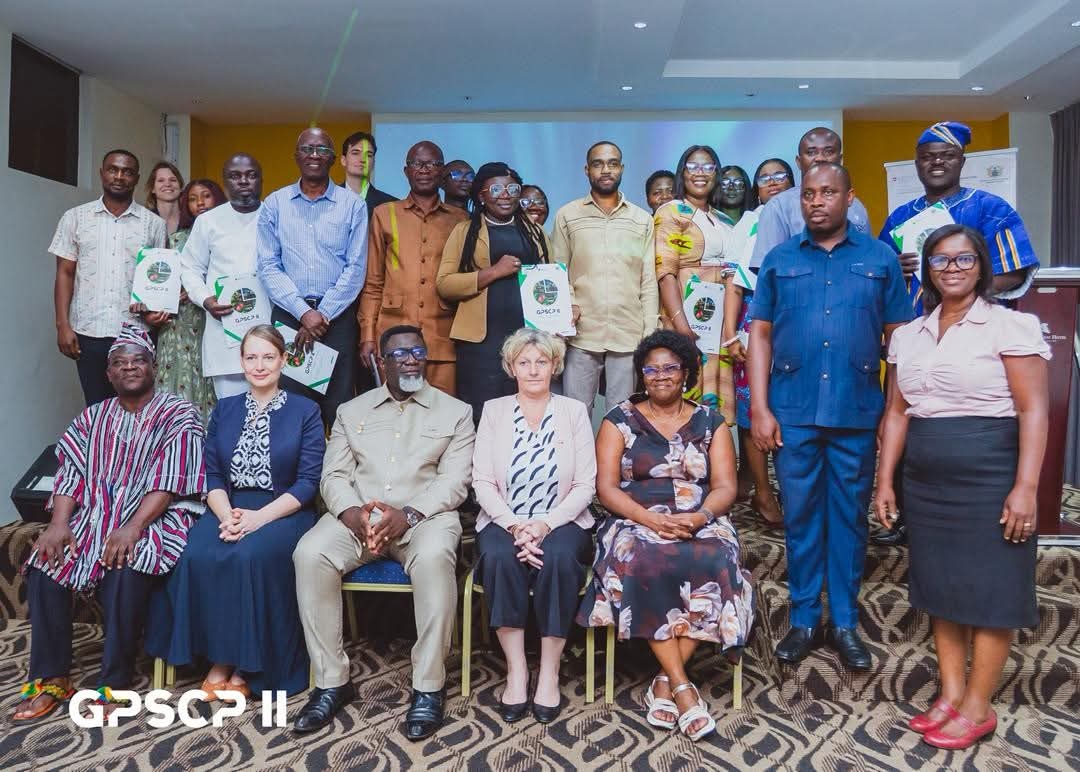
  • GPSCP II Holds 2nd Grant Award Signing Ceremony and Launches 3rd Call for Proposals

    GPSCP II Holds 2nd Grant Award Signing Ceremony and Launches 3rd Call for Proposals

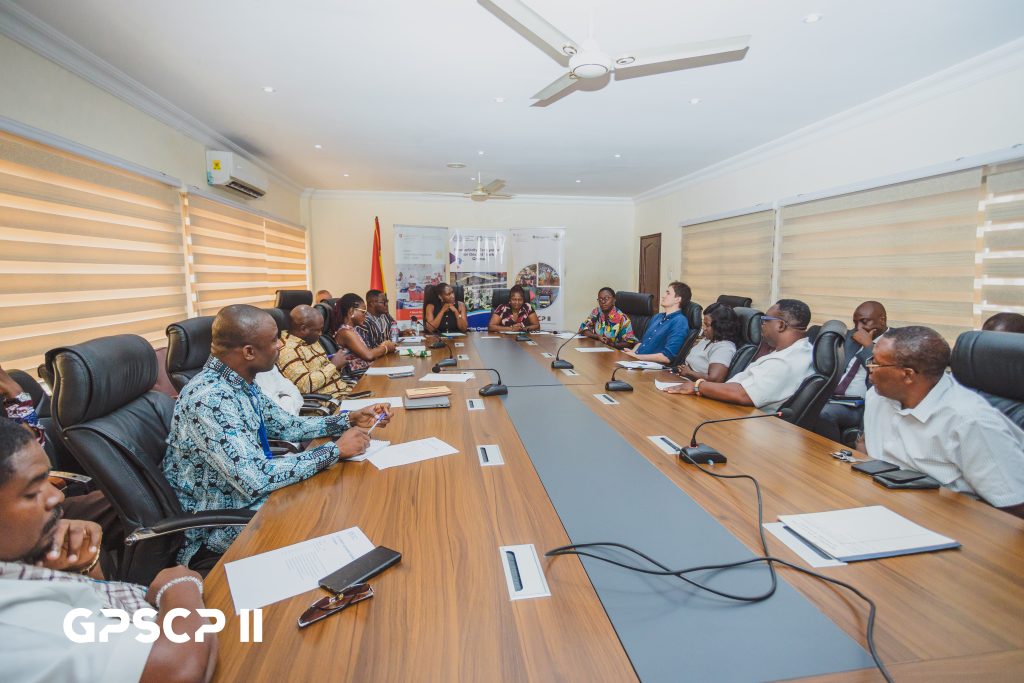
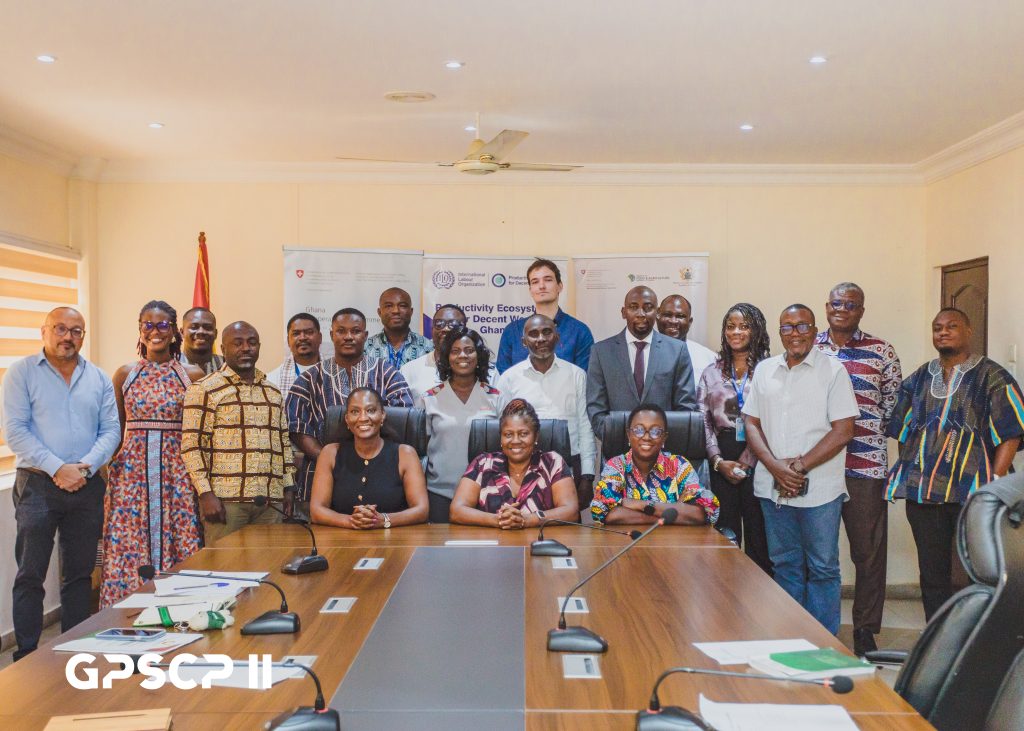
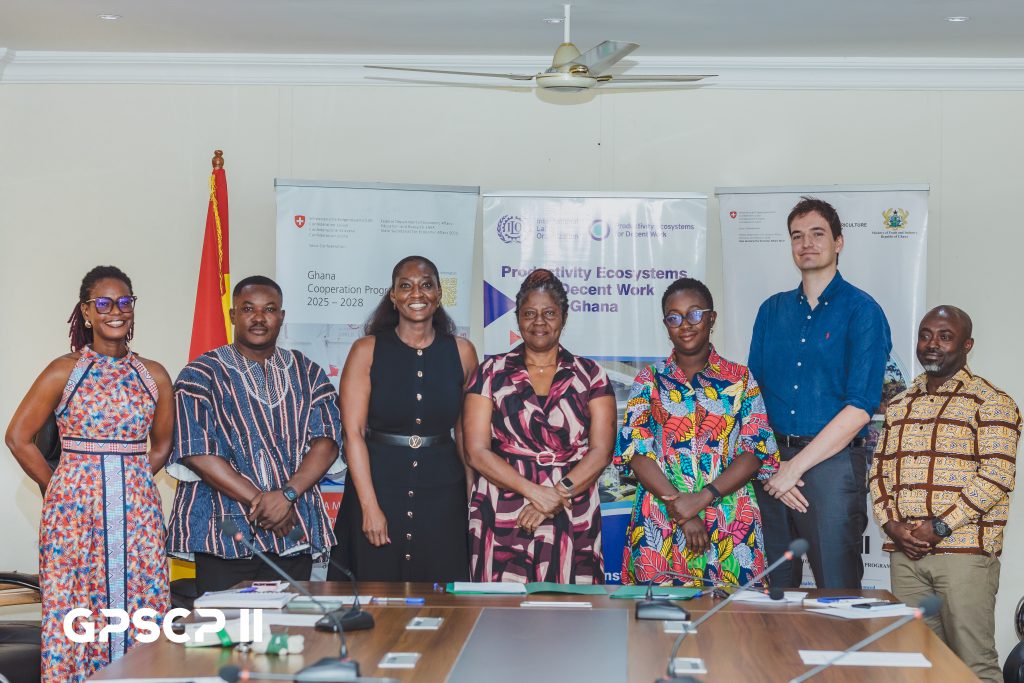
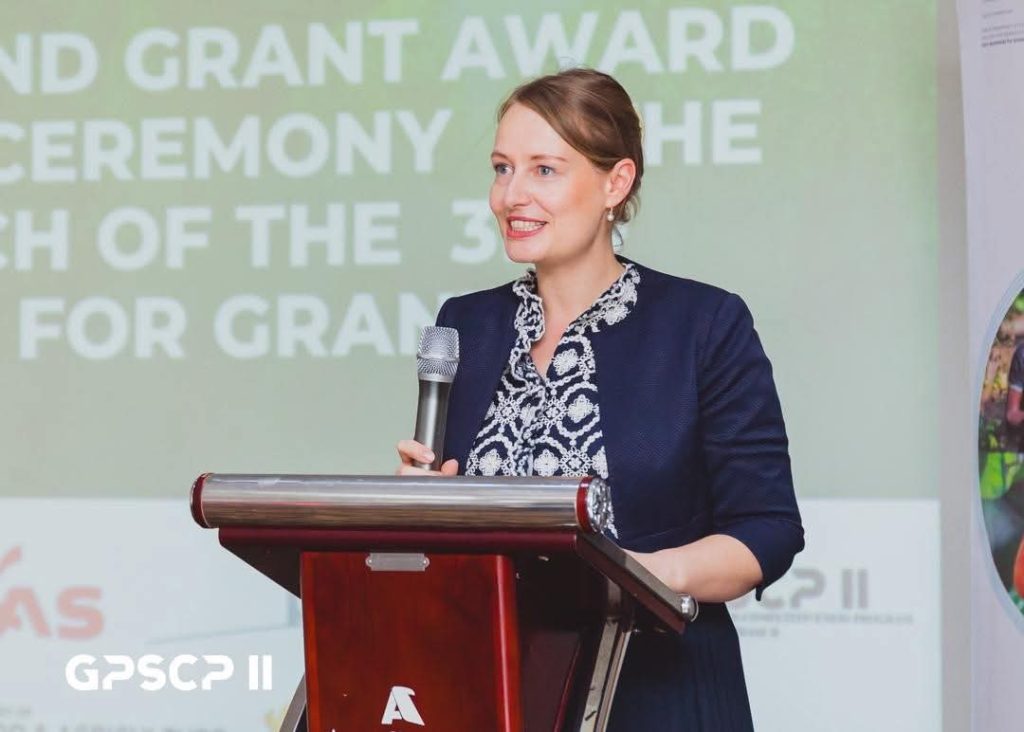
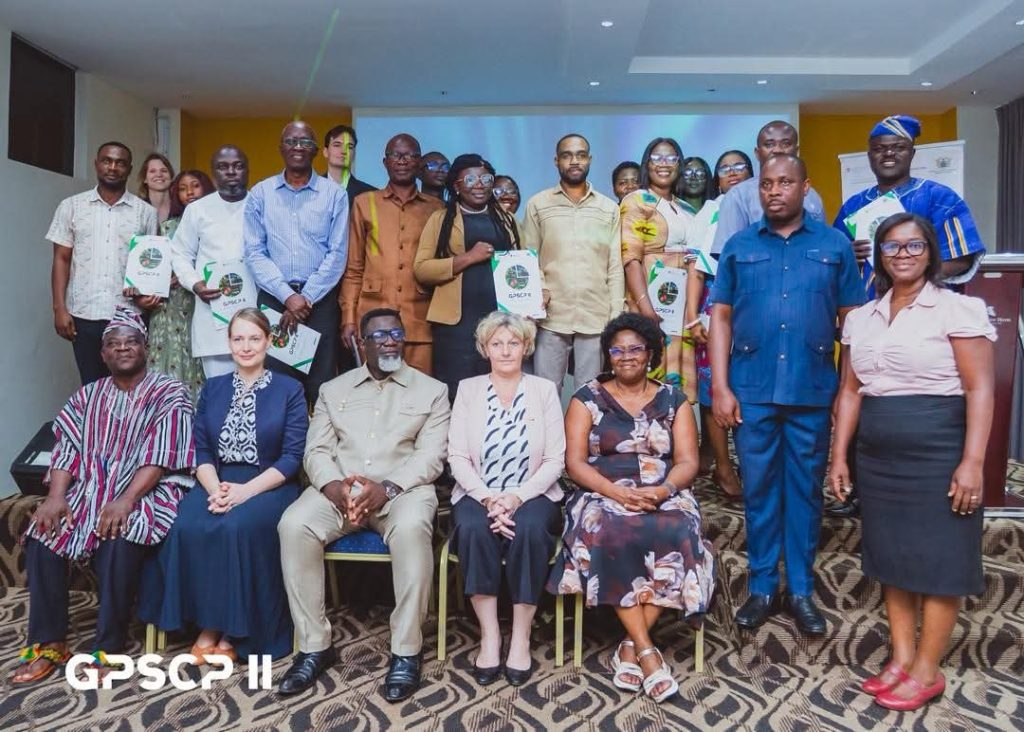
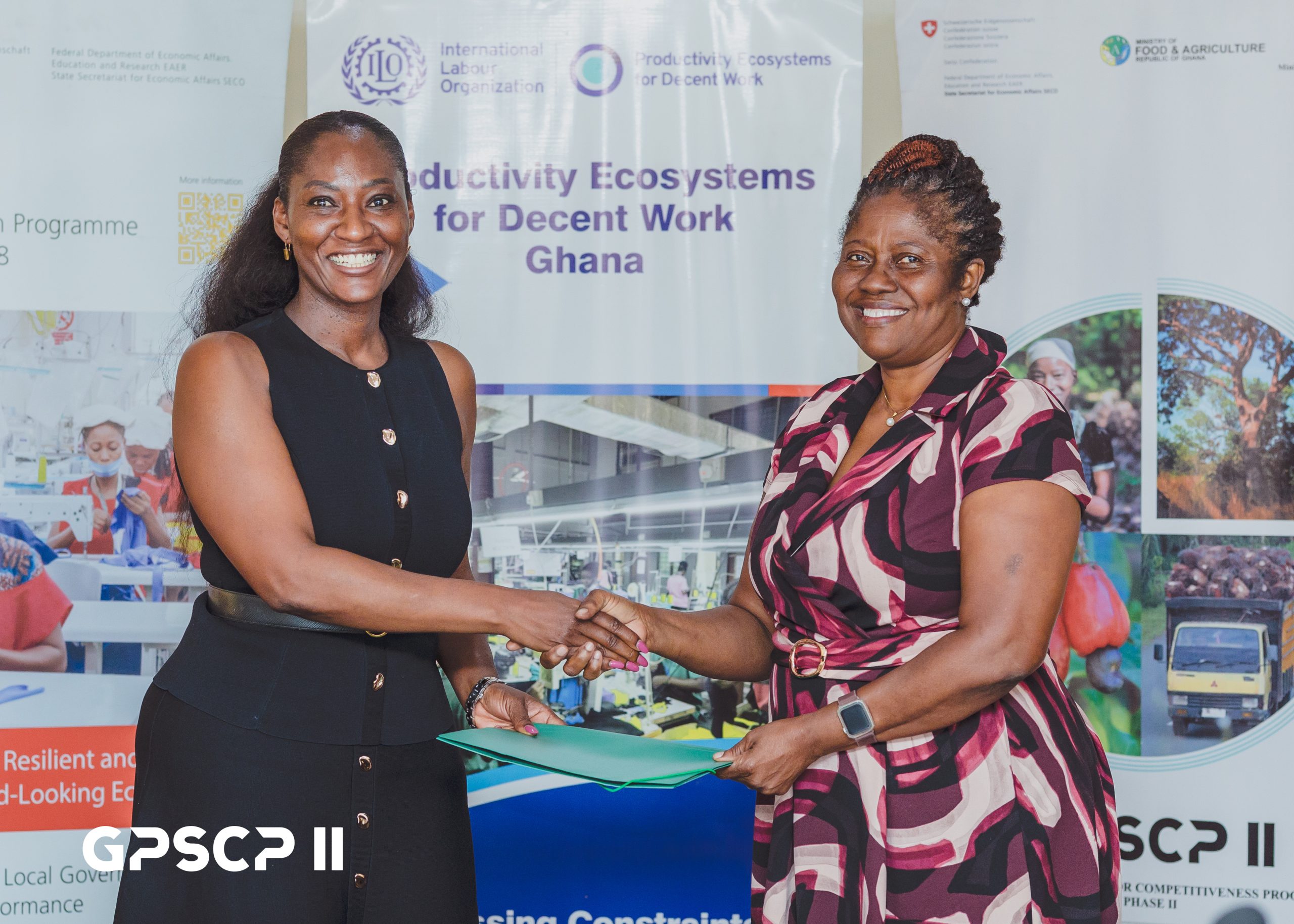
    The Ghana Private Sector Competitiveness Programme II (GPSCP II) has marked another significant milestone with the successful hosting of its Second Grant Award Signing Ceremony, alongside the official launch of the Third Call for Proposals.

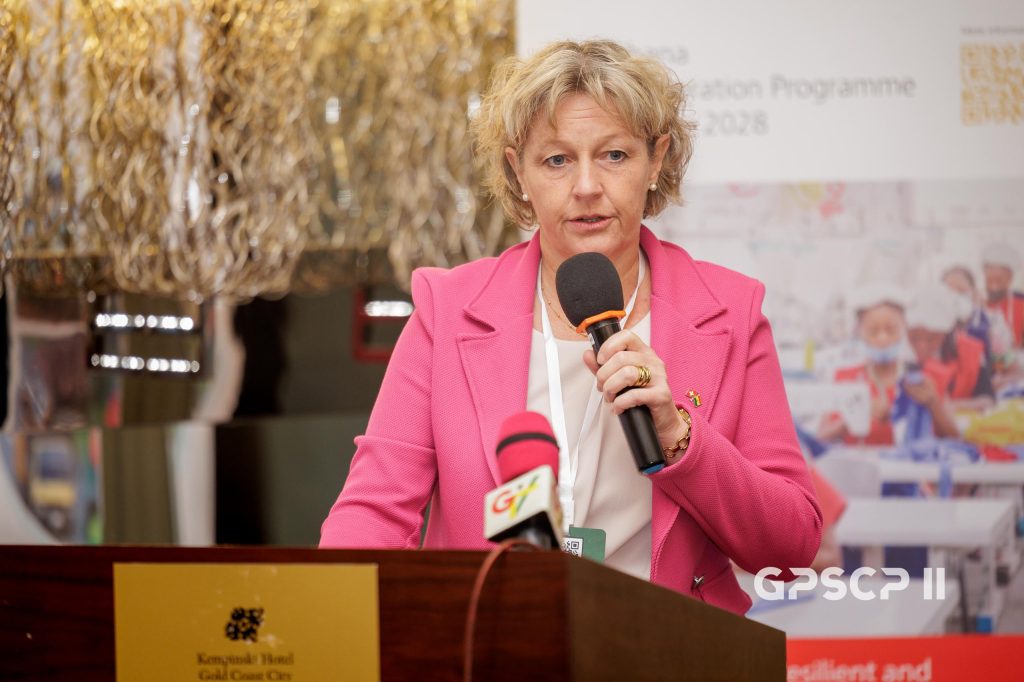
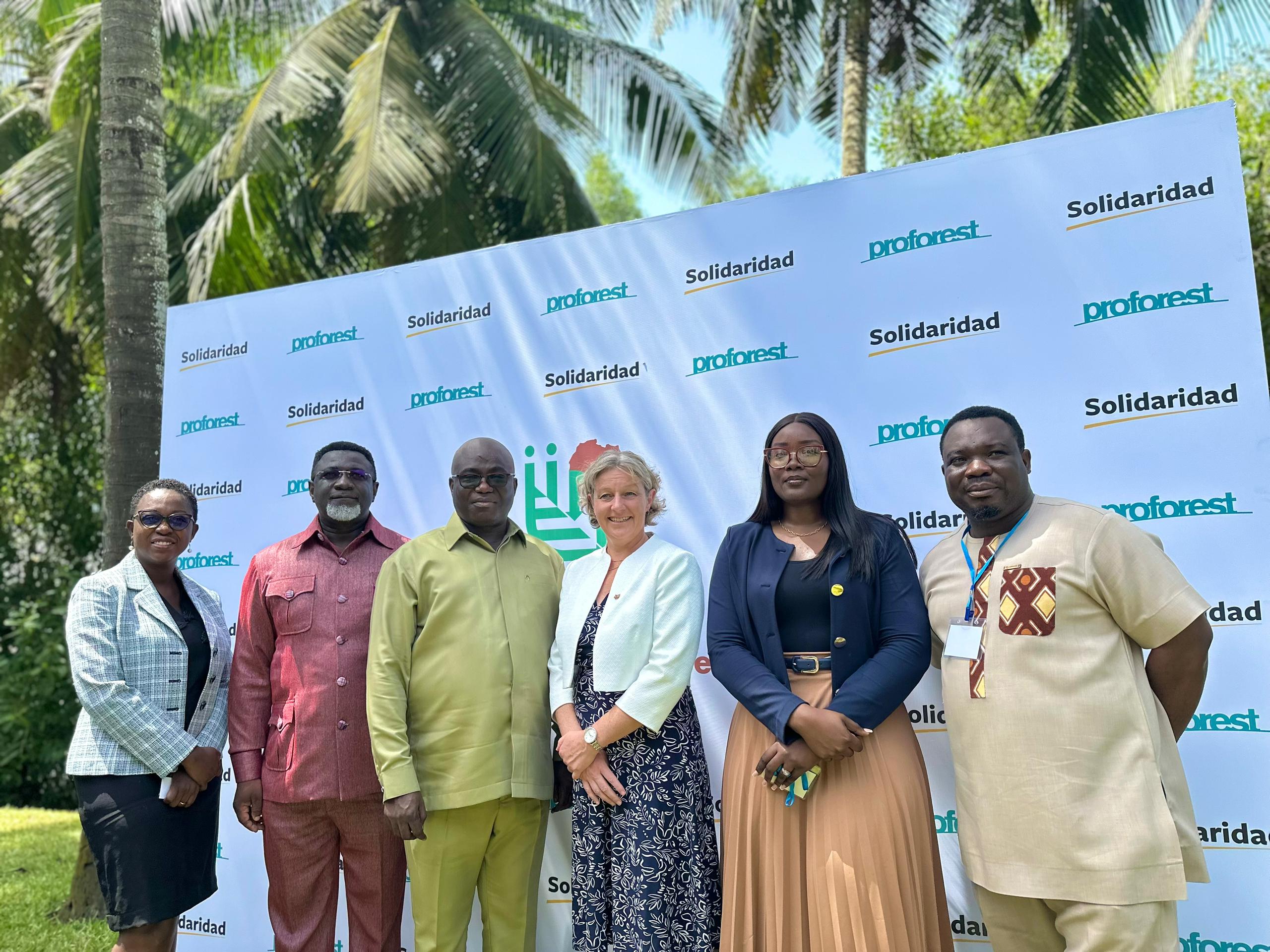
    The ceremony was witnessed by Ms. Paula Oberli, Program Manager for Private Sector Development at the Swiss State Secretariat for Economic Affairs (SECO) Headquarters, together with the SECO Ghana team. Their presence reaffirmed Switzerland’s continued commitment to strengthening Ghana’s private sector through targeted and results-driven interventions.

    Under this second grant award cycle, ten (10) enterprises operating within the oil palm and cashew value chains have been selected to receive tailored business development and technical support. These enterprises demonstrated strong potential in competitiveness, productivity, sustainability, and market expansion.

    The grants form part of GPSCP II’s broader strategy to enhance value addition, improve processing standards, and facilitate access to both domestic and international markets.

    Notably, women represent 50% of the grantees, reflecting the programme’s strong emphasis on inclusive growth and gender-responsive private sector development. This milestone underscores the commitment of GPSCP II and its partners to empowering women-led businesses and strengthening female participation across value chains.

    With each grant cycle, the programme is laying the foundation for measurable impact within Ghana’s agribusiness ecosystem particularly in the oil palm and cashew sectors, which remain critical to rural employment and industrial growth.

    During the ceremony, the Third Call for Proposals (DPP Call 3) was officially launched, opening new opportunities for additional enterprises to benefit from the matching grant facility. The launch signals continued momentum in strengthening Ghana’s private sector competitiveness through strategic partnerships and targeted financial support.

    GPSCP II is financed by the Government of Switzerland through the Swiss State Secretariat for Economic Affairs (SECO), in collaboration with key national stakeholders including the Tree Crops Development Authority (TCDA) and implemented by NIRAS.

    As the programme progresses, it remains focused on building resilient, export-oriented enterprises capable of driving sustainable economic growth and creating decent jobs across Ghana. We congratulate all grantees and look forward to witnessing the transformative impact of their projects on their businesses, their communities, and the Ghanaian economy

  • Stakeholders call for collaboration to strengthen Ghana’s Tree Crop Sector

    Stakeholders call for collaboration to strengthen Ghana’s Tree Crop Sector

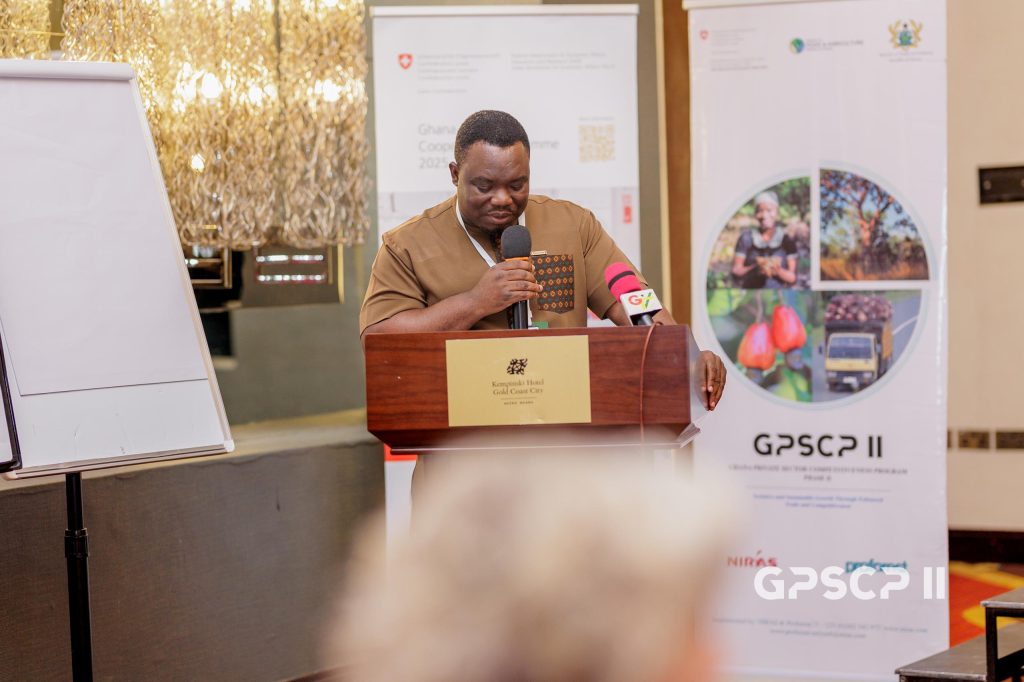
    The Team Lead of the Ghana Private Sector Competitiveness Program (GPSCP II), Juliana Ofori-Karikari is calling for coordination, governance, and competitiveness to strengthen Ghana’s growing tree crop sector.

    The Ghana Private Sector Competitiveness Program II (GPSCP II) is initiated through a bilateral initiative between the Swiss State Secretariat for Economic Affairs (SECO) and the Government of Ghana and is being implemented jointly by NIRAS International Consulting and Proforest.

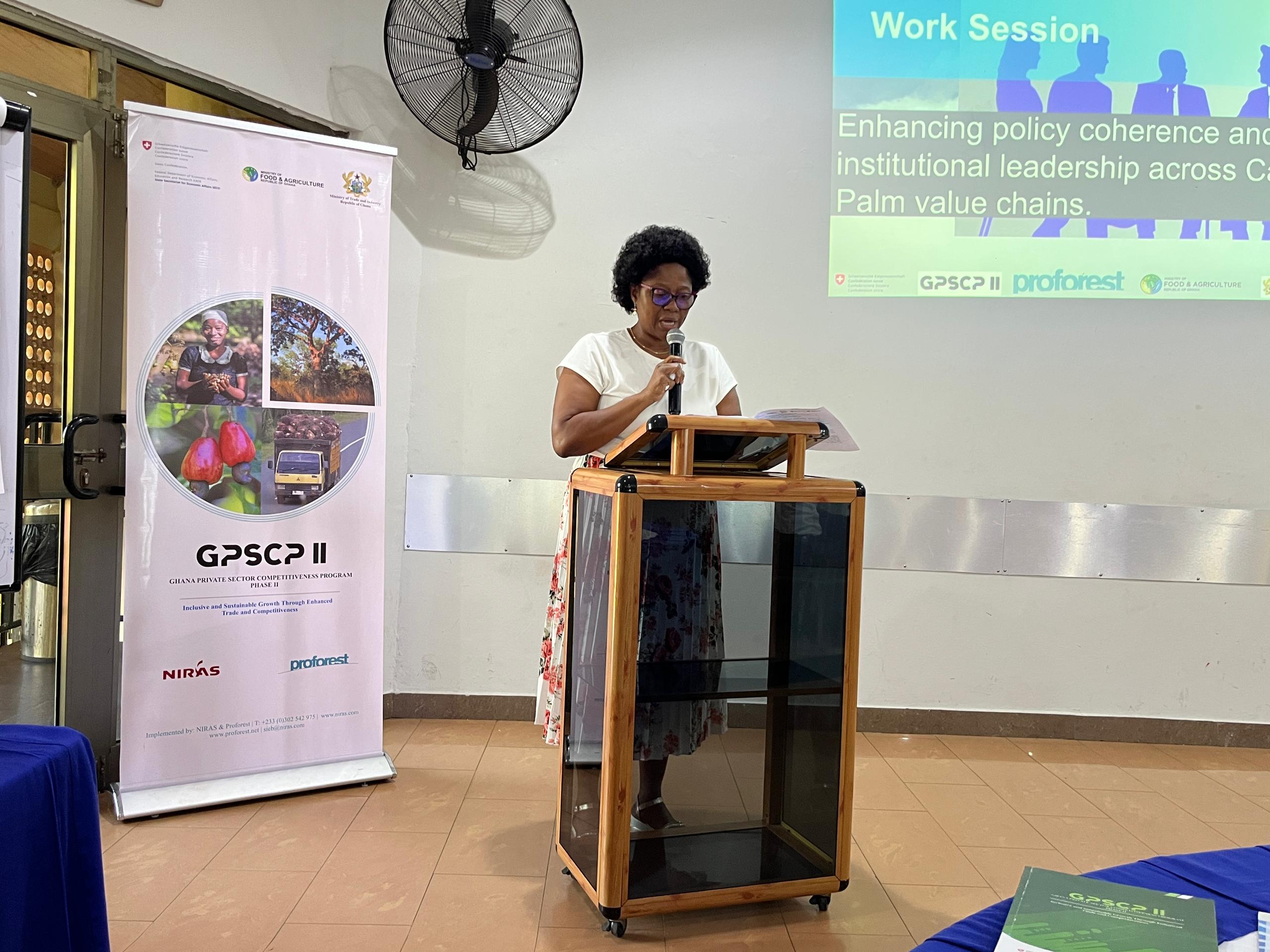
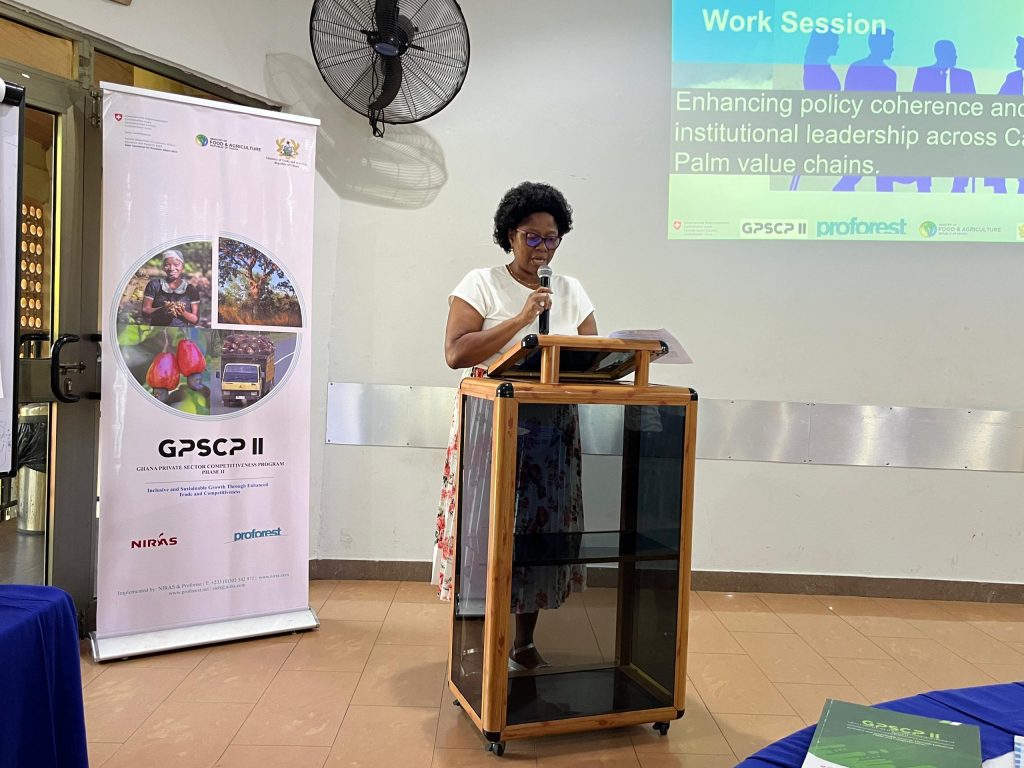
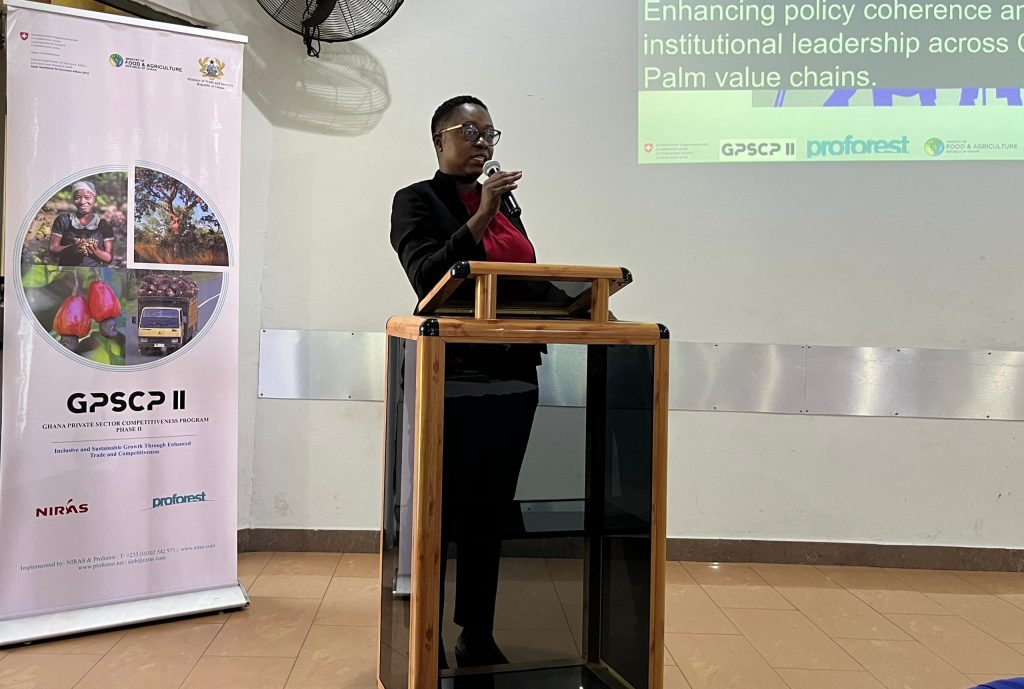
    Speaking at a policy development workshop jointly organized by the Business Regulatory Reform Unit of MOTAI and GPSCPII, aimed to collaboratively design a subproject focused on enhancing policy coherence and institutional leadership across these value chains, Team Lead, Juliana Ofori-Karikari said the success of this intervention hinges on the willingness of every institution to embrace radical transparency and collaboration.

    “The Tree Crop Sector, particularly cashew and oil palm, is not just an agricultural activity; it is a pillar of our national development. This sector holds immense, untapped potential for driving significant economic growth and generating crucial foreign exchange earnings”, she mentioned.

    Charlotte Afudego, the Private Sector Development Specialist from SECO (Swiss State Secretariat for Economic Affairs) reaffirmed the commitment of the Government of Switzerland for its continued financial and technical support toward Ghana’s tree crop agenda, describing SECO’s contribution as vital to building a globally competitive sector.

    By building on the achievements of GPSCP Phase I, the second phase (GPSCP II) aims to continuously provide an enabling environment for the cashew and palm oil sectors and contribute to higher private sector productivity and competitiveness by fostering inclusive and sustainable growth.

    Participants at the workshop focused on deriving a coordination framework including an Inter-ministerial coordination platform co-chaired by MoFA and MoTAI to align mandates and clarify institutional roles.

    The three-day workshop, marks the beginning of a comprehensive process to streamline regulatory functions and build a harmonized governance system for the cashew and oil palm value chains.

  • OPDAG 2025 Annual General Meeting

    OPDAG 2025 Annual General Meeting

    OPDAG 2025 Annual General Meeting: Charting a Sustainable Future for Ghana’s Palm Oil Sector

    Cape Coast, Ghana — September 26, 2025.


    The Organization of Palm Oil Developers’ Association of Ghana (OPDAG) held its 2025 Annual General Meeting (AGM) at the BH Hotel in Cape Coast, bringing together policymakers, processors, farmers, and private sector actors to reimagine the future of Ghana’s palm oil industry. The two-day meeting, sponsored by the Ghana Private Sector Competitiveness Programme (GPSCP II), underscored a unified call for sustainable growth, responsible practices, and deeper collaboration across the palm oil value chain.

    The conference served as a critical forum for dialogue at a time when Ghana’s oil palm sector faces rising pressures from illicit imports, low access to finance, and dwindling productivity linked to poor-quality seedlings. Yet, amid these challenges, the AGM also revealed a growing spirit of resilience and reform among industry leaders determined to reposition palm oil as a cornerstone of Ghana’s agro-industrial transformation.

    “This meeting marked more than an annual review it was a turning point,” said Mr. Paul Amaning, President of OPDAG. “Our members have moved from identifying problems to designing practical solutions that can sustain livelihoods, protect the environment, and make Ghana’s palm oil globally competitive.”

    Participants adopted a series of resolutions focused on financial sustainability, transparency, and quality assurance. A central highlight was the announcement of an OPDAG Development Fund, envisioned as a revolving facility to support farmers and processors with affordable loans for replanting, milling equipment, and value addition. This fund will be complemented by new partnerships with banks and development institutions to unlock credit for small and medium enterprises in the value chain.

    Recognizing the sector’s vulnerability to inconsistent seed quality, the AGM approved the establishment of an OPDAG Certified Nursery Program in collaboration with the Oil Palm Research Institute (OPRI). The initiative will certify nurseries, enforce quality standards, and ensure that only high-yielding hybrid Tenera seedlings are distributed to farmers.

    Delegates also adopted a comprehensive communication strategy to strengthen OPDAG’s visibility at both the national and zonal levels. This includes digital outreach, local radio engagement, and enhanced farmer training through decentralized workshops.

    A persistent concern at the AGM was the infiltration of smuggled foreign palm oils into the domestic market a trend that undermines local processors and drains national revenue. Members called for intensified collaboration with border security agencies and the Ghana Revenue Authority to clamp down on illegal imports and protect local value chains. Plans for a traceability system and public awareness campaigns were also advanced to help consumers identify and support Ghana-made palm oil.

    To extend the association’s reach, OPDAG is rolling out a grassroots mobilization strategy that empowers zonal chapters to recruit members, strengthen community partnerships, and facilitate local capacity-building. This bottom-up approach will bring the association closer to smallholders, ensuring their voices shape national advocacy and policy dialogue.

    The AGM reaffirmed OPDAG’s evolution into a credible national institution with representation on the Tree Crops Development Authority (TCDA) Board. The association’s strategic realignment toward sustainability and inclusive governance mirrors Ghana’s broader agricultural modernization agenda. The 2025–2026 operational budget, conditionally approved during the meeting, directs more funding toward training, sustainability initiatives, and the OPDAG Development Fund.

    “The energy in this year’s AGM was remarkable,” noted Frederick Sarpong, the association’s Executive Secretary. “Our members recognize that the future of Ghana’s palm oil sector depends not on technical fixes, but on building institutions that empower farmers, embrace innovation, and defend the integrity of our market.”

    As Ghana’s oil palm sector confronts global market volatility and climate pressures, the outcomes of the OPDAG AGM underscore a growing determination to turn challenges into opportunities. With renewed leadership, stronger financial mechanisms, and a deepened partnership with programs like GPSCP II, OPDAG is positioning itself as a linchpin in Ghana’s drive toward a competitive, inclusive, and sustainable palm oil economy.

  • Ghana Seeks to Transform Cashew and Oil Palm Sectors Amid Global Pressures

    Ghana Seeks to Transform Cashew and Oil Palm Sectors Amid Global Pressures

    Accra, September 29, 2025 
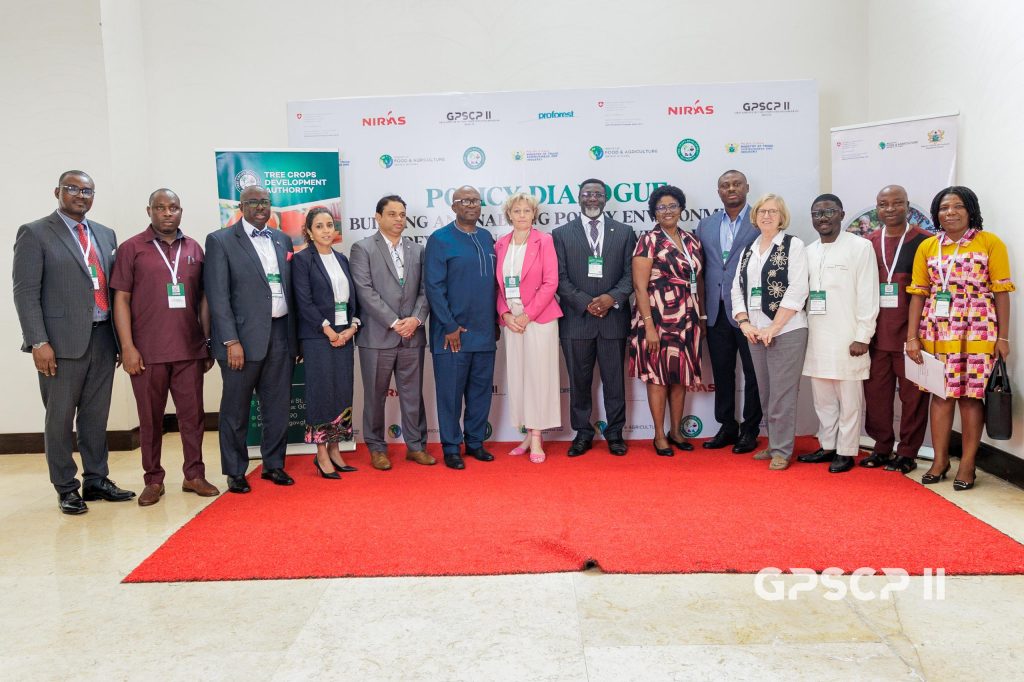
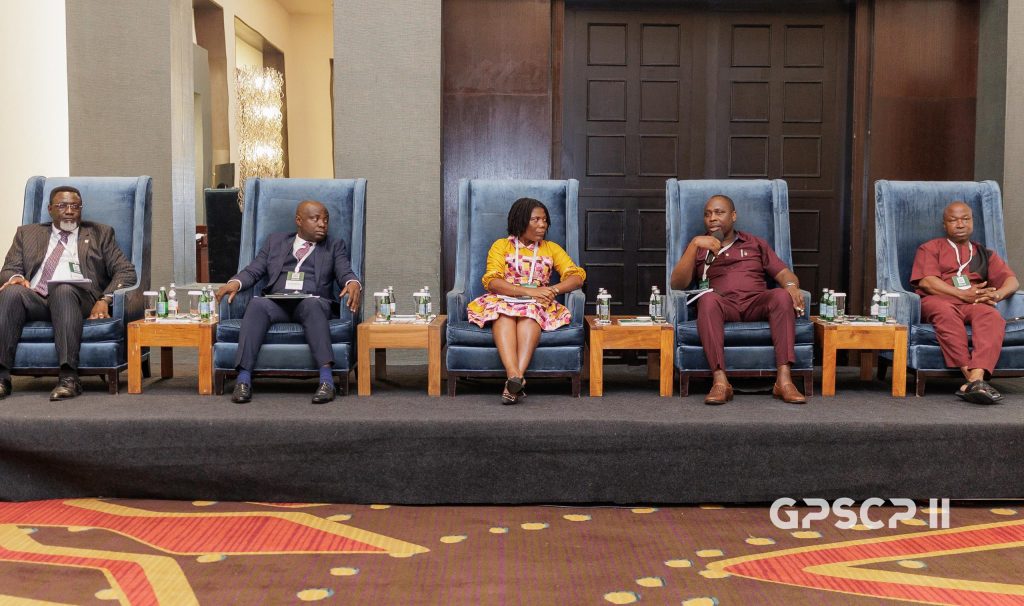
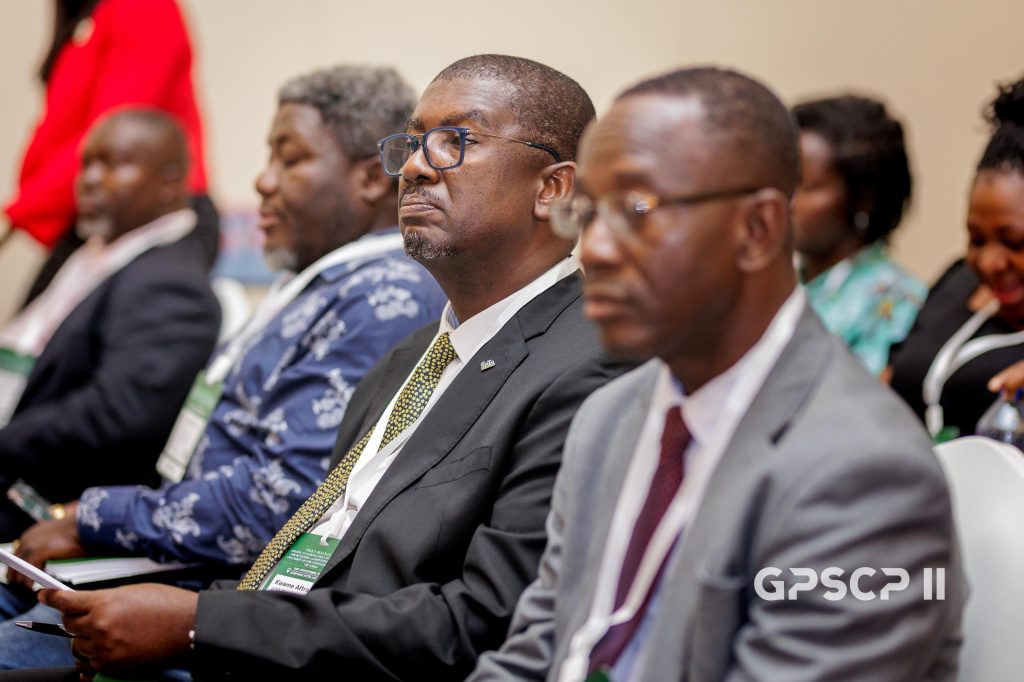
    At the Kempinski Hotel yesterday, Ghana’s policymakers, farmers, processors, academics, and international partners gathered under one roof to confront a pressing question: how can Ghana make its cashew and oil palm sectors globally competitive in an era of tightening trade rules and sustainability demands?

    The event, titled the Policy Dialogue on Cashew and Oil Palm Value Chains, was organized under the Ghana Private Sector Competitiveness Program II (GPSCP II), a bilateral initiative of the Government of Ghana and Switzerland’s State Secretariat for Economic Affairs (SECO). It was held in collaboration with the Tree Crops Development Authority (TCDA), the institution mandated to oversee the development of Ghana’s six tree crops of industrial importance.

    The theme of the dialogue “Strengthening Governance and Competitiveness in Ghana’s Cashew and Oil Palm Value Chains”  reflected the urgency of the challenge. Both crops support hundreds of thousands of smallholder farmers and generate crucial foreign exchange. Cashew alone now brings in over USD 400 million annually, while oil palm remains an indispensable source of food and raw materials for the domestic industry. Yet both sectors remain plagued by familiar constraints: overlapping mandates, weak enforcement of regulations, low farm productivity, chronic underinvestment in processing, and exposure to illegal imports that undermine local markets.

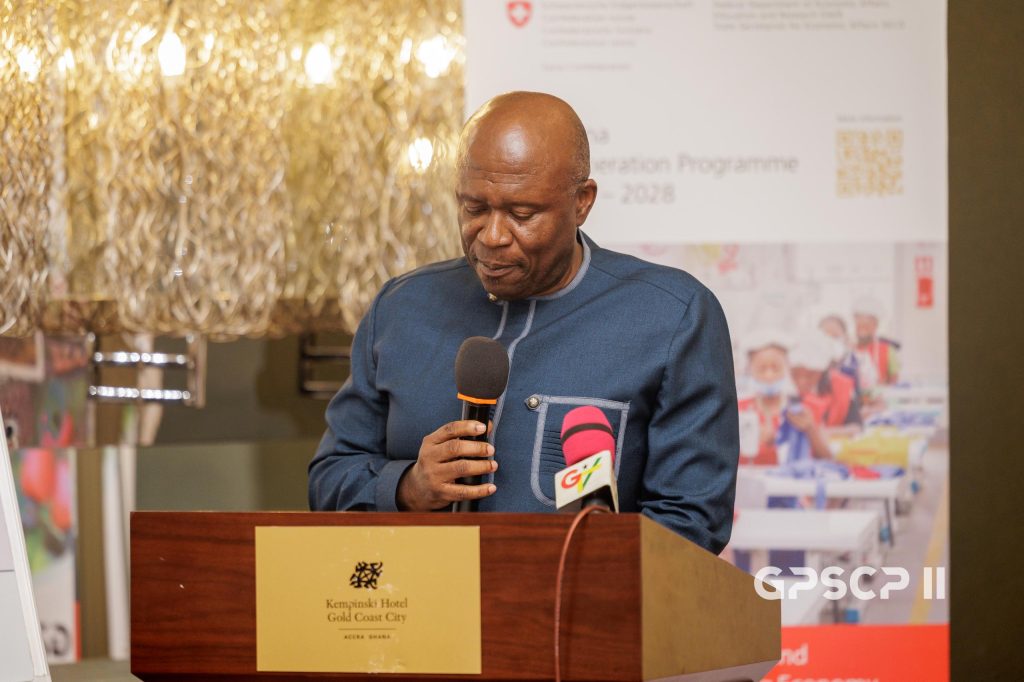
    Delivering the keynote address on behalf of the Hon. Eric Opoku, Minister for Food and Agriculture, the Ministry’s Chief Director placed the conversation in stark terms. Ghana, he said, is at an inflection point.

    We are at a crossroads,” he told the audience. “We either strengthen the institutions that govern cashew and oil palm now, or we consign our farmers to being price-takers in a global market where sustainability and compliance increasingly dictate who participates.”

    The Minister’s address laid out a candid diagnosis of the problems facing the two value chains. For oil palm, the major hurdles include low on-farm productivity, illegal importation of palm oil and vegetable oils, and weak enforcement of regulatory standards. For cashew, the concerns are somewhat different, high export of raw nuts with little value addition at home, fragmented farmer organizations, and insufficient financing for smallholder production.
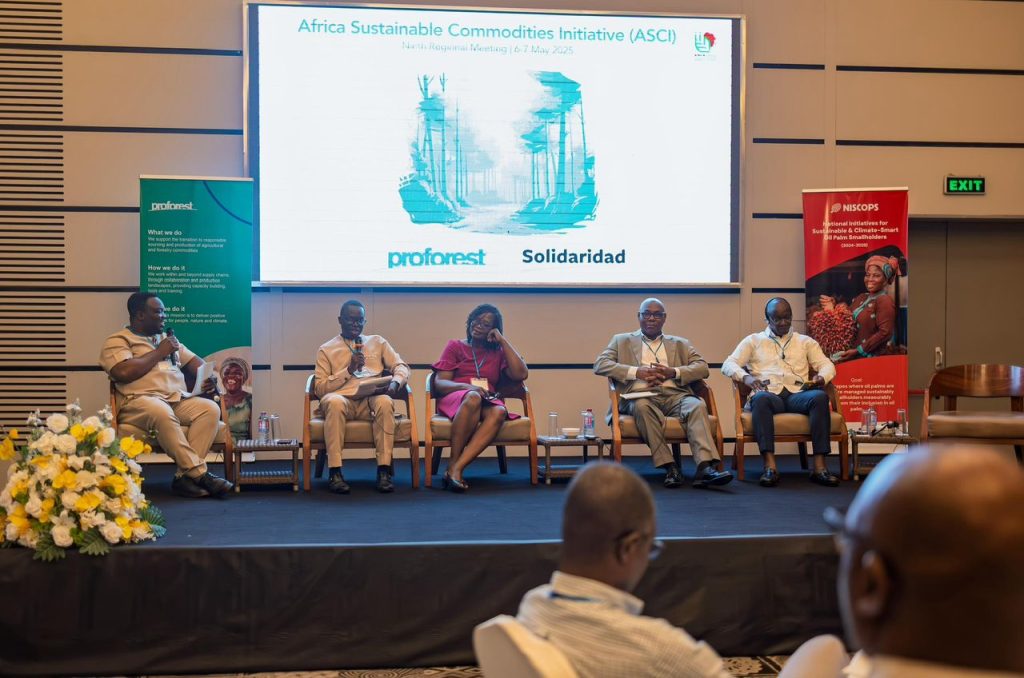
    He also highlighted that the challenges are not simply technical, but institutional and political. Multiple agencies currently share overlapping authority, from the Ministry of Trade and Industry to the Ministry of Food and Agriculture and allied regulatory bodies. This creates inefficiencies, slows decision-making, and undermines investor confidence.
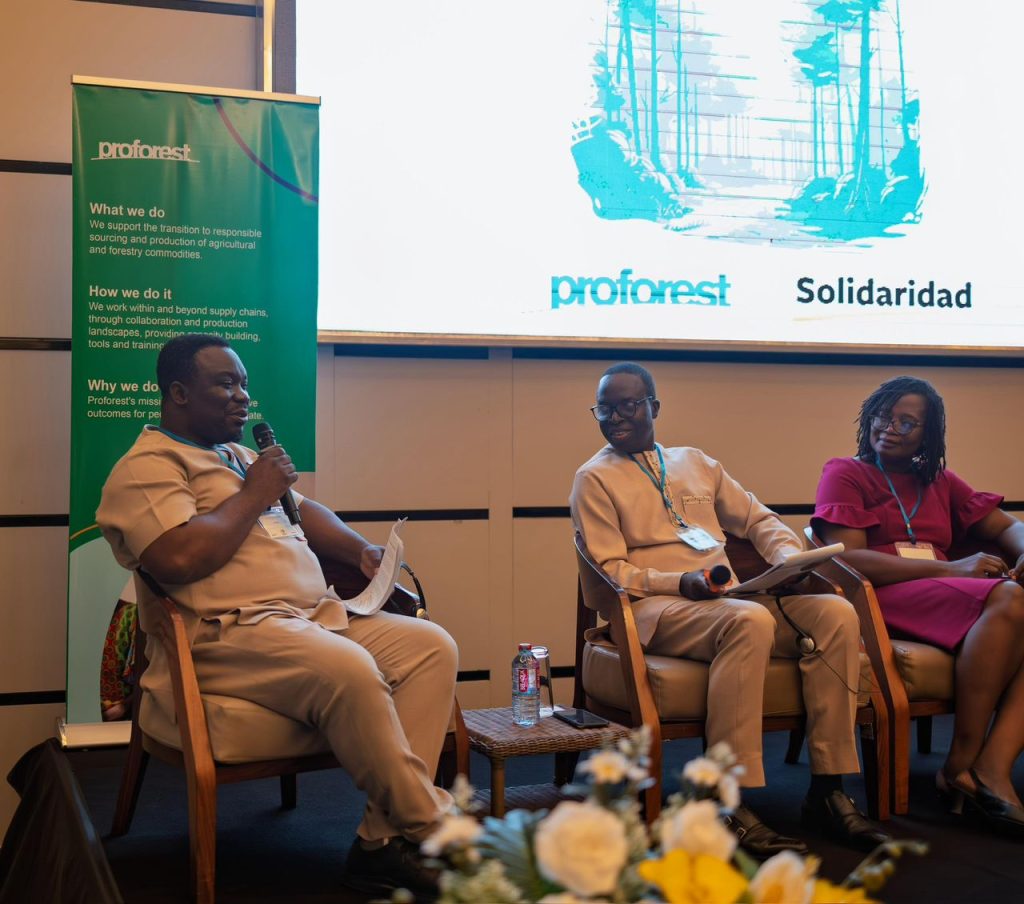
    Still, the Minister struck an optimistic note, stressing that reforms are already underway. The government’s strategy, he explained, is to empower the TCDA as the apex regulator with clearer coordination mandates. Investments are being directed toward seed certification, farmer training, and research-to-farm linkages, while new initiatives are exploring opportunities for scaling up processing and value addition.

    “Policy must not be developed in silos,” he cautioned. “It must be inclusive, evidence-driven, and harmonized across institutions. Cashew and oil palm are not simply commodities; they are lifelines for our people, and engines for rural transformation.”

    If the Minister’s keynote provided the framing, the release of the Policy and Institutional Mapping Report commissioned by GPSCP II and presented by Taylor Crabbe Initiative provided the hard data.

    The report’s conclusions were blunt without sweeping reforms, Ghana risks being left behind in a rapidly changing global trade landscape. The European Union’s deforestation regulation (EUDR) will soon require exporters to prove traceability and sustainability, or risk exclusion from the EU market. Meanwhile, the African Continental Free Trade Area (AfCFTA) offers enormous opportunities to position Ghana as a hub for regional trade but only if the country can consolidate its fragmented institutions and strengthen its regulatory regime.

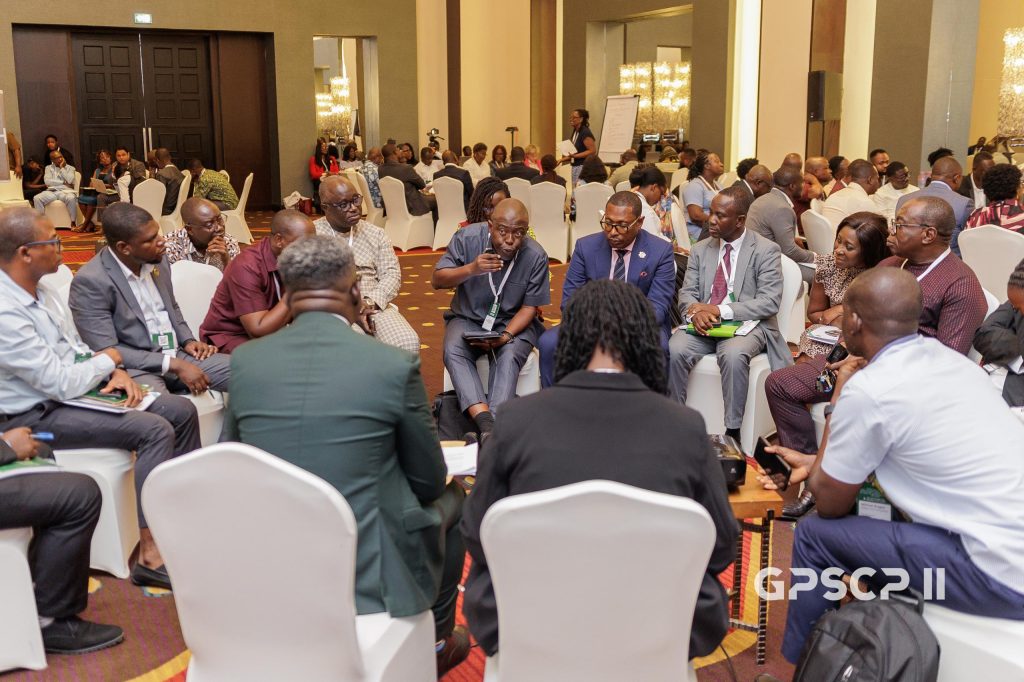
    The policy dialogue itself was designed as more than a ceremonial event. It was structured to force difficult conversations.

    Breakout sessions were convened around four thematic clusters:

    1. Institutional coordination and regulatory enforcement
    2. Investment and financing for value addition
    3. Sustainability and compliance with international market standards
    4. Farmer livelihoods and competitiveness under AfCFTA

    The project provided framing on how to sequence reforms, while the Taylor Crabbe team unpacked the institutional mapping study. The mood, several participants observed, was frank bordering on restless. Everyone in the room seemed to acknowledge that the cashew and oil palm sectors, long touted as potential engines of Ghana’s rural transformation, had been held back by inertia, turf wars, and chronic underinvestment.

    By the end of the day, the dialogue had produced a tentative roadmap for reform. Key priorities included:

    • Streamlining mandates under TCDA to reduce duplication and improve accountability.
    • Scaling up local processing capacity to reduce dependence on raw exports, especially for cashew.
    • Strengthening enforcement against illegal imports that undercut domestic oil palm producers.
    • Mobilizing private investment into processing and value addition through blended finance mechanisms.
    • Ensuring compliance with sustainability standards to keep Ghanaian products competitive in EU and other premium markets.
    • Investing in farmer productivity through improved planting materials, training, and accessible finance.

    Still, participants acknowledged that the hardest work lies ahead. Reforms agreed to in the halls of Kempinski will need to survive the grind of politics, bureaucratic turf battles, and the day-to-day realities of smallholder farmers.

    As the Minister’s representative concluded: “We cannot continue business as usual. The cashew and oil palm sectors are at the heart of Ghana’s agricultural transformation agenda. This dialogue must be the beginning of sustained action to action that strengthens governance, supports our farmers, and positions Ghana as a leader in sustainable and competitive tree crop production.”

    For now, the Policy Dialogue has set a marker. With stakeholders from government, industry, and development partners aligned on the urgency of reform, the challenge will be in execution.

    The next twelve months will be critical. Delivering on the commitments made will determine whether Ghana can seize the opportunities of AfCFTA, comply with evolving EU regulations, and finally unlock the potential of cashew and oil palm as engines of inclusive growth.

    The Kempinski meeting may be remembered as a turning point, the moment when Ghana decided that its farmers, processors, and institutions deserved more than incremental fixes, and that the time had come for bold reform.

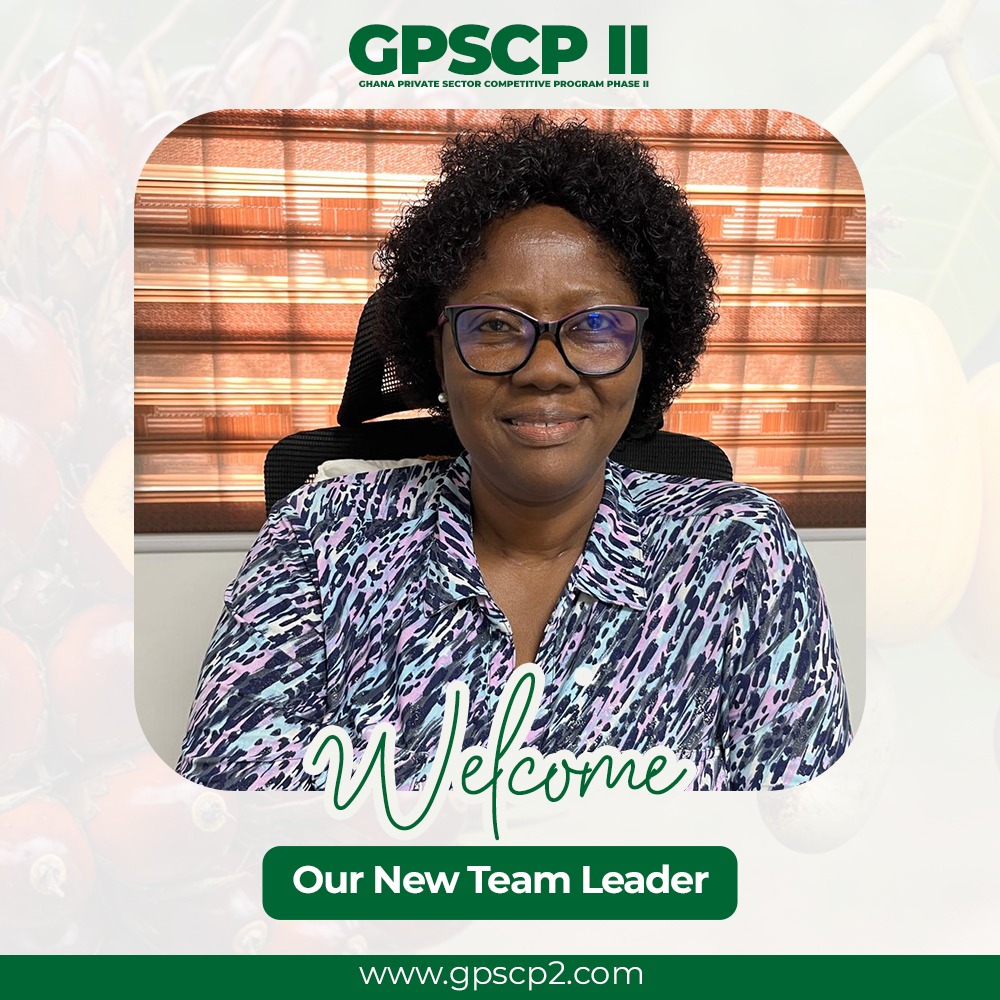
  • Welcoming Juliana Ofori-Karikari as Team Leader for GPSCP II, Ghana

    Welcoming Juliana Ofori-Karikari as Team Leader for GPSCP II, Ghana

    We are excited to welcome Mrs. Juliana Ofori-Karikari as the new Team Leader for the Ghana Private Sector Competitiveness Programme Phase II (GPSCP II)!

    Juliana brings to the role over 39 years of experience in finance, banking, investment, and enterprise development. With a rich career spanning institutions like UMB Bank and GIZ ComCashew/MOVE, she has held leadership roles across finance, credit risk, and business development—working across six West African countries to strengthen SME competitiveness in agro-processing sectors like cashew and rice.

    Her deep understanding of financial systems, business structure, and market linkages makes her an invaluable asset to the GPSCP II mission of supporting inclusive, sustainable growth through private sector partnerships.

    A passionate advocate for enterprise growth, Juliana is also known for mentoring young professionals and supporting capacity building through financial literacy and advisory services.

    Please join us in welcoming Juliana to the team as we continue to drive innovation, resilience, and competitiveness in Ghana’s agribusiness sector!

  • West and Central African Countries Unite in Accra for ASCI Regional Meeting on Sustainable Agriculture

    West and Central African Countries Unite in Accra for ASCI Regional Meeting on Sustainable Agriculture

    The project team from GPSCP II proudly participated in the 9th Regional Meeting of the Africa Sustainable Commodities Initiative (ASCI) held in Accra. This event was organized by our Program’s implementing partner, Proforest, and facilitated by our Strategic Cooperation Partnership Expert, Afua Prempeh. The landmark event brought together representatives from ten West and Central African countries to reaffirm their dedication to sustainable and inclusive agricultural production.

    ASCI serves as a pan-African platform built on a shared set of principles for the responsible production of agricultural commodities. It promotes forest protection, good governance, and transparency while ensuring that farmers, local communities, and marginalized groups benefit from agricultural value chains—particularly as the EU Deforestation Regulation (EUDR) begins to reshape market requirements.

    This year’s regional meeting focused on developing new strategies and partnerships to empower smallholder farmers against economic and environmental shocks and to align national frameworks with the EUDR, ensuring African commodities remain competitive and sustainable in global markets.

    We were honored by the presence of Ghana’s Minister of Food and Agriculture, Hon. Eric Opoku, who was the Keynote speaker and he underscored the government’s commitment to sustainable agriculture and regional collaboration.

    The Program’s Value Chain and Business Development Expert, Stephen Debre, also played a key role by moderating a session on Responsible Investment and Implications for Smallholder Development and International Trade in Oil Palm Products.

    Our participation reflects GPSCP II’s ongoing commitment to driving sustainability, enhancing climate resilience, and promoting farmer-centered development across the region.

    SustainableAgriculture #GPSCPII #ASCI #ClimateResilience #EUDR #Agroforestry #InclusiveDevelopment #WestAfrica #CentralAfrica #SmallholderFarmers

  • Swiss and Ghanaian Partners Deepen Collaboration on SME Growth in Cashew and Oil Palm Sectors

    Swiss and Ghanaian Partners Deepen Collaboration on SME Growth in Cashew and Oil Palm Sectors

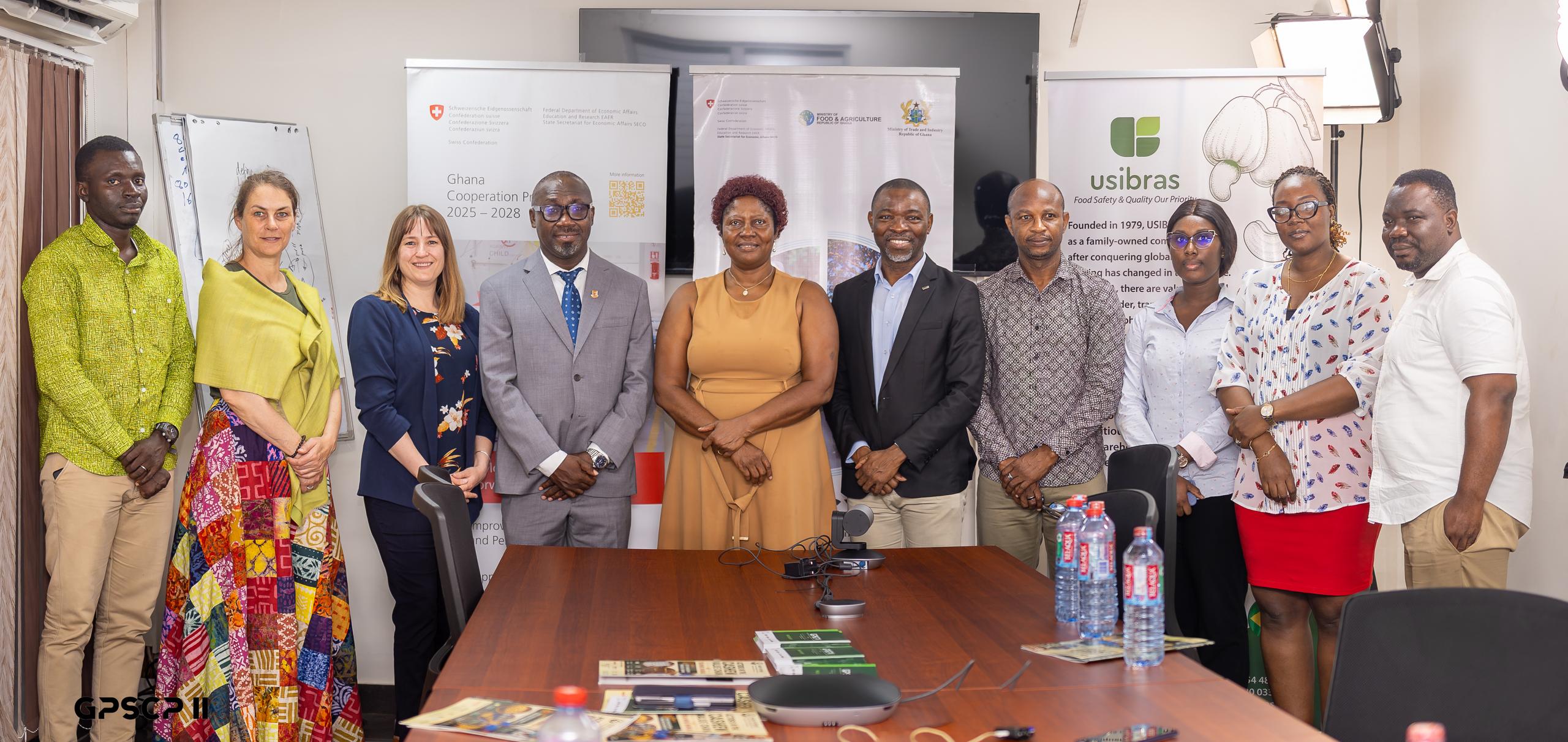
    In early April, the Ghana Private Sector Competitiveness Program II (GPSCP II) welcomed a high-level joint mission comprising officials from SECO headquarters and representatives from NIRAS headquarters. The visit marked a pivotal opportunity to engage in substantive discussions on the Program’s performance, achievements to date, and strategic reflections for the future.

    Throughout the mission, participants met with key public sector stakeholders critical to advancing the Program’s work in strengthening Ghana’s business environment for small and medium enterprises (SMEs) in the cashew and oil palm value chains. Among the notable engagements were discussions with Hon. Sampson Ahi, Deputy Minister of Trade, Agribusiness, and Industry, as well as Ebenezer A. Nortey, Head of the EU/Europe/Americas Unit at the Ministry of Finance.

    The delegation also convened with Hon. Andy Osei Okrah, the newly appointed CEO of the Tree Crops Development Authority, to review progress and reaffirm the Program’s ongoing support under the Strategic Cooperation Partnership (SCP) framework.

    Beyond public sector dialogue, the mission engaged a wide array of stakeholders within both value chains, including representatives from private sector associations such as OPDAG and CCG, as well as Proforest, the key Program partner. Field visits to two Grant Beneficiaries Homefoods Ltd., operating in oil palm processing, and Bioko Treats, a cashew processor offered an on-the-ground perspective into the dynamic evolution of value chain development and the challenges SMEs continue to navigate.

    The mission underscored the GPSCP II’s commitment to building a robust and inclusive ecosystem for Ghana’s agribusiness sectors, and reinforced collaborative efforts aimed at driving sustainable growth, innovation, and competitiveness.

  • Steering Committee Meets to Chart the Future of Ghana’s Cashew and Oil Palm Sectors

    Steering Committee Meets to Chart the Future of Ghana’s Cashew and Oil Palm Sectors

    In a decisive move toward strengthening Ghana’s agricultural competitiveness, stakeholders convened today in Accra for the Second Program Steering Committee Meeting of the Ghana Private Sector Competitiveness Programme II (GPSCP II). The gathering marked a pivotal moment in the country’s effort to drive sustainable growth in the cashew and oil palm value chains.

    The meeting, chaired by Dr. Solomon Gyan Ansah, Director of Crop Services at Ghana’s Ministry of Food and Agriculture, provided a platform to review the program’s implementation strategy, share key progress updates, and map out the path forward.

    “Today’s meeting underscores our collective commitment to building a more competitive and resilient agricultural sector,” Dr. Ansah stated in his opening remarks. “By strengthening the cashew and oil palm value chains, we not only enhance trade performance but also improve livelihoods and foster inclusive economic development.”

    Launched in January 2024, GPSCP II is a bilateral initiative supported by the Government of Ghana and Switzerland’s State Secretariat for Economic Affairs (SECO). It is jointly implemented by NIRAS and Proforest, with a mission to build a vibrant, environmentally sustainable, and socially inclusive agribusiness landscape in Ghana.

    The Programme team presented several significant milestones achieved since the inaugural committee meeting, including the launch of a grant facility supporting women-led and processing-focused SMEs in the tree crop sector. The updates demonstrated how the program is tangibly contributing to enhancing private sector competitiveness and value addition across both industries.

    Participants at the meeting including representatives from the Ministry of Trade and Industry, the Tree Crops Development Authority, SECO, NIRAS, Proforest, and other sector stakeholders engaged in collaborative discussions, offering expert insights and actionable recommendations.

    The committee emphasized the importance of maintaining alignment between field-level realities and national development priorities. Key topics included promoting climate-resilient agricultural practices, supporting gender equity in agribusiness, and deepening partnerships with the private sector.

    GPSCP II’s multi-stakeholder steering committee structure ensures that the voices of public institutions, private actors, and development partners are heard throughout the program’s implementation. Today’s session reaffirmed the importance of coordinated, data-driven, and inclusive approaches to ensure long-term impact.

    As Ghana continues its push to transform agriculture into a powerful engine for growth, meetings like these provide not only strategic guidance but also a renewed sense of shared purpose.

  • Launch Of Ghana Private Sector Competitiveness Programme Phase II

    Launch Of Ghana Private Sector Competitiveness Programme Phase II

    The Ghana Private Sector Competitiveness Program II (GPSCP II) got off to a great start in Accra last year. ⭐ Funded by the Swiss State Secretariat for Economic Affairs (SECO) in collaboration with the Government of Ghana, the bilateral program aims to contribute to inclusive and sustainable growth through enhanced trade and competitiveness in the cashew and oil palm value chains. 👩🏿‍🌾

    Attended by close to 100 participants, the GPSCP II launch event featured representatives from SECO, the Swiss Ambassador to Ghana, HE Simone Giger, Minister for Trade & Industry, Hon. K.T. Hammond, Deputy Minister for Food & Agriculture, Hon. Yaw Frimpong Addo, CEO of Tree Crops Development Authority, Hon. William Quaittoo and a Director from the Ministry of Local Government, Decentralisation and Rural Development, Mrs. Doris Agyei-Henaku. 👏🏿

    Also in attendance were the Project Director for GPSCP II (Karen Smith from NIRAS), Team Leader for GPSCP II (Ebenezer Ato Obu S., who formerly led a NIRAS-implemented Challenge Fund investing in skills development in Ghana) and Africa Regional Director for Proforest (Abraham Baffoe) and other development partners and stakeholders including from the private sector.

    NIRAS is partnering on the implementation of GPSCP II with Proforest, an NGO that supports companies throughout supply chains to have positive social and environmental outcomes in the places where commodities are produced. By building on the achievements of the first phase of GPSCP, phase II aims at continuously improving the enabling environment for the cashew and palm oil sectors. 🌴 Gender and ESG considerations are also at the heart of programme design and implementation. The GPSCP II will deliver its mandate using three implementation modalities:

    💡 Strategic Cooperation Partnership: set up to strengthen the Tree Crops Development Authority (TCDA), with its mandate of regulating the cashew and oil palm sectors and facilitate high-impact reform;

    💡 Rapid Response Mechanism: a fund through which Ministries, Departments, and Agencies under the Government of Ghana can access financial support to align and advance reform efforts that generate systemic benefits for the market systems of cashew and oil palm;

    💡 Development Partnership with the Private Sector: a matching grant fund for the private sector to strengthen processing, market linkages, service provision, sector associations, access to finance, and skills development in the cashew and oil palm value chains.

    “Taking the GPSCPII to the next level necessitates strong partnerships among relevant ministries, agencies as well as between private and public actors. We urge all stakeholders to actively participate in coordination efforts to contribute to the program’s success,” H.E Simone Giger said. “Let yourselves be inspired by Switzerland – where we have a rich tradition of deliberation, dialogue and cooperation.”

    NIRASProjects #Ghana #CashewProcessing #OilPalmProcessing #GPSCPII

  • The Ghana Private Sector Competitiveness Program II (GPSCP II) sponsors 17 Private Sector Cashew Processing Managers at the Africa Cashew Alliance’s (ACA) Masters Training Program (MTP).

    The Ghana Private Sector Competitiveness Program II (GPSCP II) sponsors 17 Private Sector Cashew Processing Managers at the Africa Cashew Alliance’s (ACA) Masters Training Program (MTP).

    The Ghana Private Sector Competitiveness Programme II (GPSCP II), implemented jointly by NIRAS International Consulting and Proforest and funded by the SECO Economic Cooperation and Development, recently supported 17 cashew processing managers at the Africa Cashew Alliance’s (ACA) Masters Training Programme (MTP). This initiative is part of the Programme’s Development Partnership with the Private Sector (DPP) mechanism, aimed at enhancing the capabilities of local private sector actors in the cashew industry, particularly those involved in processing. The training, which spanned three sessions, took place from May to August 2024 in Accra and Sunyani, Ghana, as well as in Yamoussoukro, Côte d’Ivoire. 📖

    The MTP included both classroom instruction and field visits, providing a dynamic platform for knowledge exchange. The curriculum covered various aspects of the cashew market organisation, the role of Master Trainers, the development of planting materials, best agricultural practices and the organisation of the cashew processing sector, along with cross-cutting issues such as GESI and environmental climate change. Participants also had the opportunity to visit the Wenchi Agricultural Research Station, where they engaged in practical experiences that complemented the theoretical discussions held during the training sessions. 💡

    A concerted effort was made to engage female processors in the MTP, resulting in 10 out of the 17 participants being women. Increasing female participation in the cashew value chain – particularly at managerial levels – is a key objective for GPSCPII and is aligned to SDG 5.5, which promotes women’s full and effective participation and equal opportunities for leadership in all decision-making processes across political, economic and public spheres. 👩🏾‍🏫

    Evelyn Ahiagbebu, Supervisor at Agroking Cashew Processing Limited, said: “This training has taught me that every component of the cashew fruit can be utilised. Additionally, from the gender session, I discovered that women have greater prospects in secondary processing since it requires less capital than primary processing.”

    As for Joseph Kwasi Sie, Lead Supervisor at Kabile Co-operative Cashew Farmers and Processors Society Limited, he said: “I was initially unfamiliar with the process of cashew apple processing, but this training has provided me with essential skills that I can now apply at Kabile Co-operative.”

    This collaborative initiative is one of the many efforts that GPSCPII is undertaking to foster a supportive environment for the cashew value chain, ultimately aiming to boost productivity and competitiveness in the sector. ✅

    Ghana #SDG5 #EconomicGrowth #PrivateSector #Cashew #CashewProcessing #NIRAS #GPSCPII